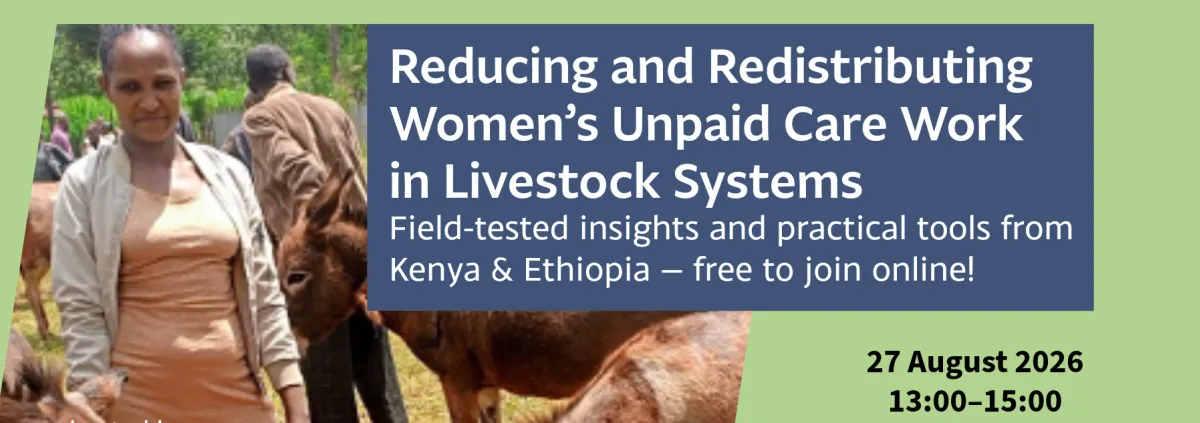

Discover how bundled socio-technical innovations can improve work balance and enhance women’s empowerment in smallholder livestock systems, drawing on evidence and practical tools from Kenya & Ethiopia.
Women and girls in rural Kenya and Ethiopia often carry a disproportionate share of unpaid care work—cooking, collecting water and firewood, caring for children and older family members, and supporting household livelihoods. In smallholder livestock systems, the daily labour of fetching water and transporting forage for animals can add hours of physically demanding work, restricting women’s time for paid work, leadership, education, and wellbeing.
To address this hidden burden, Ripple Effect – together with the International Livestock Research Institute (ILRI), Centre for Rights Education and Awareness (CREAW), Women Empowerment Action, and We Effect, with funding from the International Development Research Corporation – is implementing the Scaling Innovations for Reduced and Redistributed Women’s Unpaid Care Work (I4RR) project in Bungoma County, Kenya and Wolayta, Ethiopia. The project is testing a socio-technical bundle of innovations—including improved forage production, the use of donkeys to transport water and feed, and gender-transformative approaches such as THM and SASA! (Start, Awareness, Support, Action)—to reduce and redistribute unpaid care work and strengthen women’s empowerment.
This webinar brings together researchers and implementers to share early evidence, implementation lessons, and practical ways participants can adapt the SASA! tool to their own contexts.
What you’ll learn
What the research is testing, why it matters, and emerging insights from Kenya and Ethiopia
How bundling childcare services with livestock feed innovations can reduce and redistribute unpaid care work
Implementation experience and lessons from partner organisations
How changes in power relations and empowerment are assessed (including links between SASA and empowerment measurement approaches)
How to adapt and apply the SASA! guiding questions and related survey tools to your own programme area
Who should attend
Programme implementers, researchers, policymakers, funders, and practitioners working on:
gender equality and women’s empowerment
rural livelihoods and livestock systems
childcare and care services
labour-saving technologies
gender-transformative approaches and social norms change
Speakers
Sofanit Mesfin
Regional Gender and Social Inclusion Coordinator, Ripple Effect
For over 10 years, Sofanit has been building gender and social inclusion into Ripple Effect projects through participatory community tools and training. Because her role involves working across east Africa, Sofanit covers gender and social inclusion issues in different sectors, countries and contexts, and collaborates with teams across Africa to share learnings. Sofanit is inspired by the families she works with, their positive experiences, and the lasting transformation which continues to give new meaning to her work.
Immaculate Omondi
Gender Research Economist, International Livestock Research Institute (ILRI)
Ms. Omondi is an agricultural economist working on strategic gender research and hands-on tracking and measuring progress in gender towards gender equality. She is also an experienced monitoring, learning and evaluation expert. Immaculate holds a PhD. in Agricultural Economics from the University of Giessen, Germany. Her current research focus is on the nexus between gender equity, livestock value chains and policy.
Angelina Cikanda
Fundraising and Program Development Manager at Centre for Rights Education and Awareness
Angelina is an experienced Gender & Development Specialist working with the Centre for Rights Education and Awareness (CREAW), national feminist women's rights non-governmental organization based in Kenya. She is Accredited SASA! Model Technical Advisor. She has also worked with at-risk populations including refugees, Urban Informal settlements, rural communities, and LGBTQ people.
Julie Koehler (Moderator)
Head of Gender (Data in Livestock Development), SEBI-Livestock
Julie Koehler is passionate about leading behaviour change processes that support deeper inclusion and gender integration within teams. As Head of Gender (Data in Livestock Development) she leads collaborations that support the use of data towards transformative change. Julie has 20 years of experience in humanitarian response, development, and academia, and has worked to build and deliver systems, processes and structures that help integrate gender across portfolios from country teams to global initiatives. She has worked with teams across sectors and contexts to get past challenges and implement solutions. She is a convener of people and a facilitator of collaborative and empowering spaces.
Please log in or sign up to comment.