
🚀 Start Your IPTV Free Trial Today
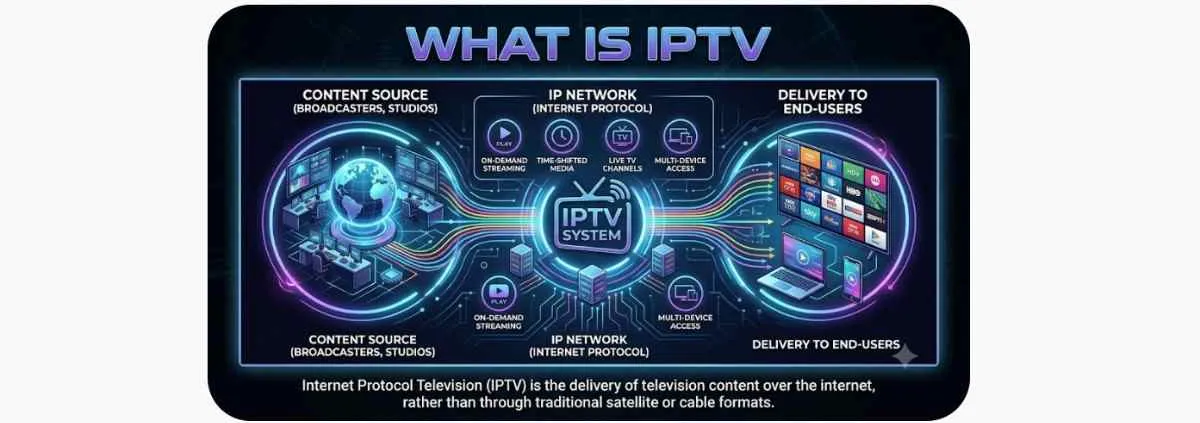
Quick Answer: IPTV, or Internet Protocol Television, delivers TV channels and video content over an internet connection instead of through traditional cable, satellite, or broadcast antenna signals. A subscription's video data travels from the provider's servers through your internet connection to a player app on your device, which decodes and displays it as a watchable stream.
The term IPTV comes up constantly in discussions about cutting the cord, but the actual mechanics of how it works are often glossed over. Understanding what happens between a provider's servers and your TV screen makes it much easier to evaluate specific services and troubleshoot problems when they come up.
🚀 Start Your IPTV Free Trial Today
What IPTV Actually Means
IPTV stands for Internet Protocol Television, referring to any television service delivered using standard internet data protocols rather than traditional broadcast methods like cable coaxial lines, satellite dishes, or over-the-air antenna signals. In practice, this means your TV content travels over the same kind of internet connection you use for browsing the web or streaming video elsewhere.
It's worth being precise about what this term does and doesn't imply. IPTV is a delivery method, not a specific brand, app, or content library — mainstream services like many major streaming platforms technically use IPTV delivery methods for at least part of their content, even though people rarely use the term "IPTV" to describe them. When people search for "what is IPTV," they're usually asking about smaller providers that specifically brand themselves around live channel packages delivered this way.
How the Technology Actually Works, Step by Step
Understanding the basic data path clarifies a lot of confusion about IPTV. Here's what happens between a provider and your screen:
- Content ingestion — the provider receives live channel feeds or video files and encodes them into a format suitable for internet delivery.
- Server distribution — the encoded content sits on the provider's servers, organized into a channel list or catalog, typically accessed through what's called an M3U playlist (a file listing available channels and their streaming addresses).
- Your internet connection carries the data — when you select a channel or program, your device requests that specific stream from the provider's server over your home internet connection.
- A player app decodes the stream — an app on your device (such as IPTV Smarters or a similar M3U-compatible player) receives the incoming data and decodes it into a watchable video feed.
- Display on screen — the decoded stream displays on your TV, phone, tablet, or computer, functioning similarly to watching any other streaming video.
This entire process happens in real time for live channels, which is why a stable, sufficiently fast internet connection matters more for IPTV than it does for traditional cable or satellite delivery.
🚀 Start Your IPTV Free Trial Today
IPTV vs Traditional Cable and Satellite: What's Different
The core difference comes down to the transmission method, which affects reliability, infrastructure requirements, and flexibility differently for each option.
| Factor | IPTV | Cable | Satellite |
|---|---|---|---|
| Delivery method | Internet connection | Coaxial cable line | Satellite dish signal |
| Dependent on | Internet speed and stability | Physical cable infrastructure | Clear line of sight to satellite |
| Weather sensitivity | Generally low | Very low | Can be affected by heavy weather |
| Device flexibility | Works on many device types via apps | Requires cable box/compatible TV | Requires satellite receiver |
| Setup | App-based, often across multiple devices | Professional installation typically required | Professional installation typically required |
None of these delivery methods is inherently better in every situation — a household with unreliable internet service may find cable or satellite more consistent, while a household with strong broadband may prefer IPTV's device flexibility.
What You Need to Use IPTV
Getting IPTV set up requires a few specific pieces working together, and missing any one of them is a common source of setup frustration:
- A sufficiently fast, stable internet connection — streaming, especially in higher resolutions, requires more consistent bandwidth than basic web browsing.
- A compatible device — a smart TV, streaming box, phone, tablet, or computer capable of running a player app.
- A player app — software like IPTV Smarters or a similar M3U-compatible app that loads and displays the provider's channel list.
- An active IPTV subscription — the actual content source, which is separate from both the device and the player app.
A detail that's easy to overlook: the player app and the subscription are two separate things provided by different parties, and confusing them is a common mistake for people new to IPTV. The app just displays whatever content your subscription provides — it doesn't include channels on its own.
🚀 Start Your IPTV Free Trial Today
Is IPTV Legal?
Using IPTV as a technology is completely legal — it's simply a method of delivering television content over the internet, the same underlying approach used by many mainstream, fully licensed streaming platforms. The technology itself carries no legal risk.
The legal question depends entirely on the specific service or content source you use, not the delivery method. A provider needs proper licensing rights to distribute the channels and on-demand content it offers; when it lacks those rights, using that specific service can raise legal and reliability concerns, even though IPTV as a general concept remains legal. Watch for warning signs like an unusually large channel lineup, including premium sports packages, offered at a price far below what licensed competitors charge — that's a common indicator of unlicensed redistribution rather than a genuine bargain. The Federal Trade Commission publishes general consumer guidance on identifying subscription and streaming scams, useful background if you're evaluating a specific provider's legitimacy.
Common Uses for IPTV
IPTV setups generally serve a few common purposes, and understanding which one applies to your situation helps clarify what to look for in a service:
- Replacing traditional cable or satellite with a live channel package delivered over the internet.
- Accessing international or regional channels not typically available through local cable providers.
- Combining live TV with on-demand content in a single subscription, rather than juggling separate services.
- Business use, such as hospitality or commercial settings that need flexible channel access across multiple screens.
🚀 Start Your IPTV Free Trial Today
Conclusion
IPTV delivers television content over an internet connection instead of traditional cable, satellite, or broadcast signals, using a chain of server distribution, your internet connection, and a player app to bring channels and on-demand content to your screen. The technology itself is legal and widely used, including by many mainstream streaming platforms — what determines legal risk is the licensing status of the specific service you choose, not the delivery method itself. Understanding this distinction is the most useful starting point before comparing specific IPTV providers.
Frequently Asked Questions
Is IPTV the same as streaming services like the ones I already use?
IPTV refers to the underlying delivery method, and many mainstream streaming platforms technically use similar internet-based delivery. The term "IPTV" in everyday use usually refers specifically to providers offering live channel packages rather than on-demand-only platforms.
Do I need special equipment to use IPTV?
You need a compatible device (smart TV, streaming box, phone, or tablet), a player app, and an active subscription, but no specialized hardware beyond what many households already own. A stable internet connection matters more than any particular device.
Is IPTV legal to use?
Yes, IPTV as a technology is legal — it's simply internet-delivered television. Legal risk depends on whether the specific service you subscribe to has proper licensing for its content, not on the delivery method itself.
Why does my IPTV stream sometimes buffer or freeze?
Buffering is usually related to your internet connection's speed and stability rather than the IPTV technology itself, since live streams require consistent bandwidth. Checking your connection during peak usage hours can help identify whether that's the cause.
Can I use IPTV on my current smart TV?
Most modern smart TVs support IPTV player apps, though compatibility varies by brand and model. Checking your specific TV's app store or supported device list before subscribing is a reliable way to confirm compatibility.
What's the difference between an IPTV app and an IPTV subscription?
The app is the software that displays content on your device, while the subscription is the actual content source you're paying for. They come from different providers, and one doesn't work without the other.
Please log in or sign up to comment.