
🚀 Start Your IPTV Free Trial Today 🚀
👉 Get Instant IPTV Access Now 👈
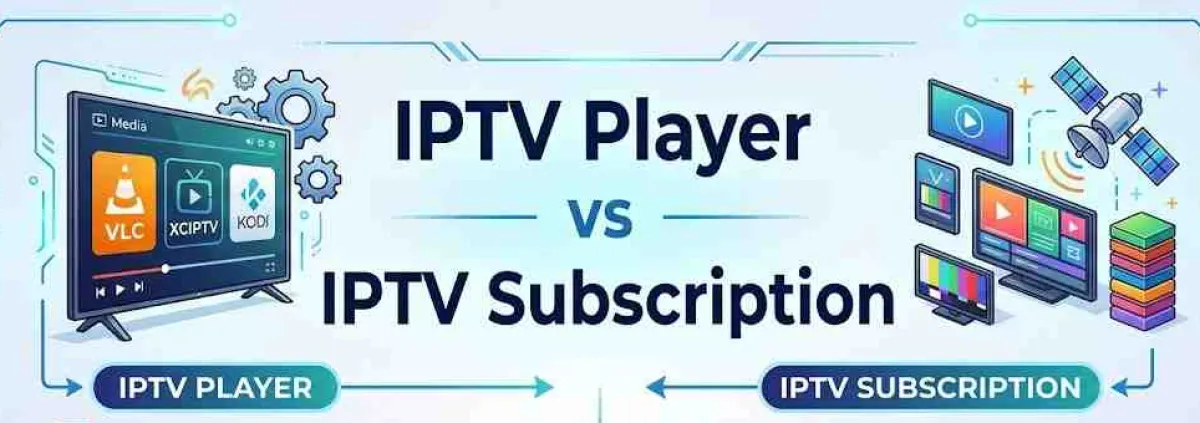
Quick Answer: An IPTV player is an app, such as IPTV Smarters or Smart IPTV, that displays video content on your device — it doesn't include any channels itself. An IPTV subscription is the separate service that actually supplies the channels and on-demand content the player displays. You need both together; neither works alone.
This is one of the most common points of confusion for anyone new to IPTV: the player app and the subscription sound like they should be the same thing, but they come from entirely different providers and serve entirely different roles. Understanding the split makes troubleshooting, comparing options, and avoiding wasted purchases much easier.
What an IPTV Player Actually Does
An IPTV player is software — typically an app like IPTV Smarters, Smart IPTV, or a similar M3U-compatible player — that runs on your device and decodes incoming video data into a watchable stream. Think of it as the equivalent of a media player app on a computer: it plays whatever file or stream you point it at, but doesn't generate that content itself.
Most IPTV players work by accepting a playlist URL or login credentials, which tells the app where to fetch channel and video data from. Once connected, the player organises that content into a browsable interface — channel lists, an on-demand library, sometimes an electronic programme guide (EPG) showing what's currently airing. The player's job ends there; it has no say in what channels are available or whether they're properly licensed.
🚀 Start Your IPTV Free Trial Today 🚀
👉 Get Instant IPTV Access Now 👈
What an IPTV Subscription Actually Provides
An IPTV subscription is the separate service you pay for that actually supplies the live channels and on-demand video content. This is where the real content comes from — the subscription provider ingests and distributes the channel feeds, and your player app simply displays whatever that subscription makes available.
Subscriptions vary considerably in what they include: some focus mainly on live channels, others bundle a substantial on-demand library, and some include catch-up TV for recently aired programmes. Pricing, channel selection, and content licensing are all determined at the subscription level, not by whichever player app you happen to use to view it.
Why the Confusion Happens So Often
The confusion largely comes from the fact that both the player and the subscription are essential to actually watching anything, and marketing language doesn't always make the split obvious. Someone might download a well-reviewed player app expecting it to include channels, only to find an empty interface until a subscription is added.
Adding to the confusion, some player apps and subscription providers are sold or bundled together by resellers, blurring the line between the two even further. It's worth remembering that, structurally, they remain two separate products from two separate sources, even when purchased at the same time.
🚀 Start Your IPTV Free Trial Today 🚀
👉 Get Instant IPTV Access Now 👈
How the Two Actually Work Together
Understanding the basic setup sequence clarifies the relationship between them:
- You choose and install a player app on your device (smart TV, Firestick, phone, or tablet).
- You separately subscribe to an IPTV service that provides the actual channel and content lineup.
- You enter the subscription's connection details into the player — typically a playlist URL, or a username and password, depending on the provider.
- The player fetches and displays the subscription's content, organising it into a usable interface.
Neither step is optional. A player without a subscription shows an empty app; a subscription without a compatible player has no way to actually display its content on your screen.
Comparing the Two Directly
| IPTV Player | IPTV Subscription | |
|---|---|---|
| What it is | An app that displays content | A service that supplies content |
| Determines | Interface, device compatibility, EPG display | Channel lineup, pricing, content licensing |
| Typical cost | Often free, sometimes a small one-off fee | Recurring subscription cost |
| Provider | App developer (e.g., a player app maker) | Separate content provider |
| Legal responsibility | Legal on its own, since it's just software | Depends on whether it holds proper content licensing |
This distinction also explains why troubleshooting IPTV problems usually starts by identifying which side the issue is on — a player crashing or failing to install is an app problem, while missing channels or poor stream quality more often points to the subscription.
🚀 Start Your IPTV Free Trial Today 🚀
👉 Get Instant IPTV Access Now 👈
Why This Distinction Matters for Legal Risk
This is arguably the most important reason to understand the split: using an IPTV player app is legal in the same way using any media player is legal — it's simply software that displays video, and doesn't host or distribute content itself. The legal question sits entirely on the subscription side.
A subscription needs proper licensing rights to distribute the channels and on-demand content it offers. When it lacks those rights, using that specific subscription can raise legal and reliability concerns — but this has nothing to do with which player app you happen to use to view it. Be cautious of any subscription offering an unusually large channel lineup, including premium sports packages, at a price far below licensed competitors, since that's a common sign of unlicensed redistribution rather than a genuine bargain. In the UK, the Federation Against Copyright Theft (FACT) addresses unlicensed content distribution, while Ofcom covers broader broadcasting standards — both are useful references if you're unsure about a specific provider's legitimacy.
Choosing a Player and Subscription Separately
Because these are two independent decisions, it's worth evaluating them on separate criteria rather than treating "which IPTV service should I get" as a single question.
For a player app, prioritise:
- Compatibility with your specific devices (smart TV brand, Firestick, phone).
- Interface features that matter to you, such as an EPG or customisable channel lists.
- Whether it's actively maintained and updated by its developer.
For a subscription, prioritise:
- Transparency about content licensing.
- A channel and on-demand lineup that matches your actual viewing habits.
- A genuine free trial period to test reliability before committing to a longer plan.
🚀 Start Your IPTV Free Trial Today 🚀
👉 Get Instant IPTV Access Now 👈
Conclusion
An IPTV player and an IPTV subscription are two separate products that work together but come from different providers — the player is the app that displays content, while the subscription is the service that supplies it. Understanding this split makes it much easier to troubleshoot problems, compare options fairly, and evaluate legal risk accurately, since licensing concerns sit with the subscription, not the player app itself.
Frequently Asked Questions
Do I need to pay for both an IPTV player and a subscription?
Many player apps are free or have a small one-off cost, while the subscription is typically the ongoing recurring expense. You generally need both, even if only one involves a regular payment.
Can I use the same IPTV player with different subscriptions?
In most cases yes, since many players accept a standard playlist URL or login format compatible with multiple providers. Check your specific player's documentation to confirm which subscription formats it supports.
Is an IPTV player illegal to use?
No, an IPTV player is simply software that displays video content, similar to any media player app. Legal risk relates to whether the subscription you connect to it has proper content licensing, not to the player itself.
Why do I have channels missing even though my player app works fine?
This usually points to a subscription-side issue rather than a problem with the player app itself. Contact your subscription provider directly to check for service outages or account issues.
What's an EPG, and does it come from the player or the subscription?
An electronic programme guide (EPG) shows what's currently airing and up next, and it's typically displayed by the player app using schedule data supplied by the subscription. Both parts need to work correctly for the EPG to display accurately.
How do I know if my IPTV subscription is properly licensed?
Look for transparency about content partnerships and be cautious of pricing far below licensed competitors offering the same channels. A subscription provider that avoids questions about licensing is a warning sign worth taking seriously.
Please log in or sign up to comment.