
🚀 Start Your IPTV Free Trial Today 🚀
👉 Get Instant IPTV Access Now 👈
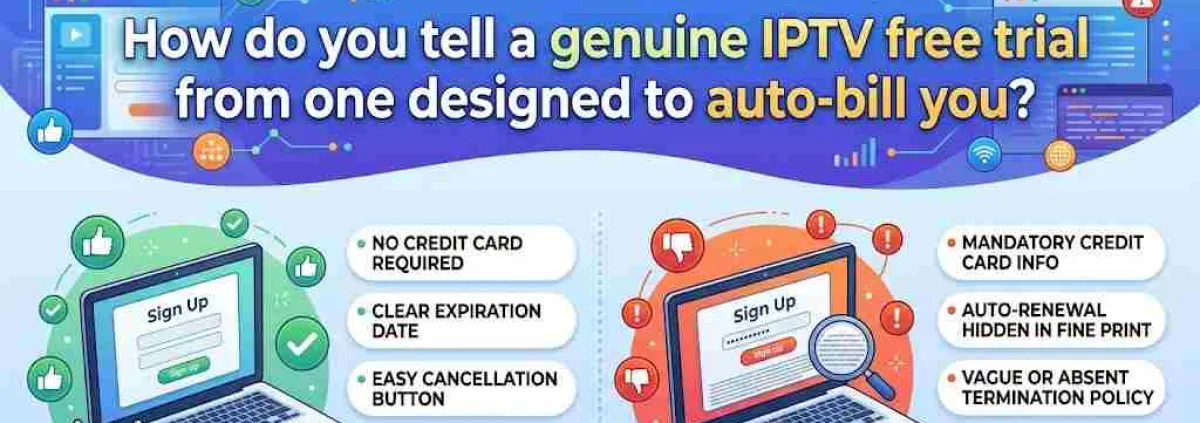
Quick answer: A genuine IPTV free trial lets you test streaming quality without requiring payment card details upfront, or clearly states the exact date billing starts. If a "free trial" demands card details immediately, buries the cancellation date, or promises hundreds of premium channels for almost nothing, it's more likely designed to auto-bill you than to let you evaluate honestly.
How do you tell a genuine IPTV free trial from one designed to auto-bill you? The honest answer is that most of the warning signs sit in the sign-up process itself, not in how good the streaming looks once you're inside. Genuine trials from licensed providers are usually upfront about what happens next — when billing starts, how to cancel, and what you actually get to test. Trials designed to convert you into a paying customer without a clear decision point tend to blur exactly those details, because ambiguity works in the provider's favour.
This matters more with IPTV than with most other subscriptions, because the term covers two very different markets. On one side, established UK names — Sky, Virgin Media, BT, TalkTalk, Vodafone, and lightweight apps like TVPlayer — offer trials of properly licensed services. On the other, a large grey market of unofficial IPTV resellers uses "free trial" language to get card details and lock people into recurring payments for content they may not have the rights to distribute in the first place. This guide focuses on how to evaluate any iptv free trial you're offered, and how to separate the two.
🚀 Start Your IPTV Free Trial Today 🚀
👉 Get Instant IPTV Access Now 👈
What a Genuine IPTV Free Trial Actually Looks Like
A genuine trial gives you a real, time-limited window to test the service, with clear terms about what happens when that window closes. It doesn't rely on you forgetting to cancel.
The hallmarks of a trustworthy trial are fairly consistent across legitimate UK subscription services generally, not just IPTV:
- A specific end date stated at sign-up, not a vague "trial period" with no fixed length
- Clear confirmation of what price you'll be charged and when, if you don't cancel
- A working cancellation method that doesn't require phoning a number that's never answered
- No requirement to enter full payment details for trials genuinely marketed as "no card needed"
- Terms of service and a registered company name you can actually verify
If a provider is licensed to distribute the channels or content it's advertising, it usually has no reason to hide these details, because a confident business doesn't need to make cancellation difficult to keep customers. This is one of the more reliable signals across the whole IPTV services market, not just for identifying scams but for identifying providers worth using long-term at all.
🚀 Start Your IPTV Free Trial Today 🚀
👉 Get Instant IPTV Access Now 👈
Common Auto-Bill Tactics to Watch For
The tactics that convert a "free" trial into an unwanted charge tend to follow a small set of patterns, and once you know them, they're easy to spot before you sign up.
Watch for these specific red flags:
- Card details required before you can even see the interface. Legitimate trial-testing shouldn't require full payment authorisation just to preview a channel list.
- A trial length that's oddly specific and short, like 24 or 48 hours, designed to expire before most people get round to testing it properly or deciding to cancel.
- No visible cancellation button inside the account, forcing you to contact support directly — a tactic sometimes called "confirmshaming" in UX research, where cancelling is made deliberately harder than signing up.
- Pricing that seems too good against known market rates. If a trial leads into a package offering thousands of live channels, every UK sports subscription, and multiple premium streaming platforms combined for a few pounds a month, that pricing doesn't reflect what those broadcasting rights actually cost — which is a strong sign the underlying service isn't properly licensed at all.
- Auto-renewal buried in small print rather than stated clearly at the point of sign-up.
None of this means IPTV as a technology is untrustworthy — it's simply that trial mechanics get used more aggressively in this particular market than in most other UK subscription categories, partly because of how competitive and unregulated parts of the unofficial reseller space have become.
Is It Legal? Licensing and Consumer Protection for IPTV Trials in the UK
IPTV technology is completely legal in the UK — it's simply a method of delivering television over an internet connection rather than satellite or cable. What determines whether a specific trial or service is legitimate is whether the provider actually holds the rights to the content it's offering.
UK consumer protection law gives you some backing here too. Under UK consumer contract regulations, businesses generally need to give clear information about subscription costs and cancellation rights before you agree to pay, and misleading pricing or hidden auto-renewal terms can fall foul of wider consumer protection rules enforced by bodies such as the Competition and Markets Authority. That said, enforcement against unlicensed overseas IPTV resellers is inconsistent, so the practical protection you get from these rules is far stronger with an established UK provider than with an anonymous playlist seller operating from outside typical regulatory reach.
A separate legal point worth understanding clearly: using an unlicensed IPTV source, even during a "trial," isn't a grey area protected by consumer law — the Digital Economy Act 2017 covers unauthorised redistribution of broadcast content, and that risk sits with the source of the content, not the underlying IPTV technology.
🚀 Start Your IPTV Free Trial Today 🚀
👉 Get Instant IPTV Access Now 👈
How to Test an IPTV Free Trial Properly Before Committing
Testing a trial properly means putting it under the same conditions you'd actually use it in, not just checking that a few channels load during a quiet afternoon.
A more useful testing approach looks like this:
- Test during peak viewing hours, particularly a live sports fixture or a popular evening broadcast — this is when buffering and server strain actually show up, not during low-demand daytime hours
- Check catch-up and on-demand content loads correctly, not just live channels
- Confirm how many devices can stream simultaneously if your household watches on more than one screen
- Note exactly what date you signed up and calendar a reminder several days before the trial ends, regardless of what the provider tells you the end date is
- Screenshot or save the terms shown at sign-up, in case the pricing or cancellation process looks different later
One practical insight that's easy to miss: the quality of customer support during the trial period is often a better predictor of long-term reliability than the streaming quality itself. A provider that responds clearly and specifically to a technical question before you've paid anything is more likely to still exist — and still support you — in six months, compared with one that only sends automated replies.
IPTV Free Trial vs Paid Plan: What Actually Changes
The core difference between a trial and a paid plan isn't usually the technology — it's what you're allowed to evaluate versus what you're committing to long-term.
| What to compare | During free trial | After converting to paid |
|---|---|---|
| Channel access | Often full access, sometimes a limited preview tier | Full access as advertised |
| Device limit | May be restricted to one device | Full simultaneous-stream allowance |
| Support response | Test this actively — it's revealing | Should match or exceed trial-period responsiveness |
| Cancellation | Should be simple and clearly timed | Contract terms and notice periods apply |
| Pricing | Free or heavily discounted | Full advertised rate, confirm before trial ends |
If a provider's paid plan looks meaningfully different from what the trial showed — fewer channels, a lower device limit, degraded stream quality — that's worth querying directly with the provider before your trial period ends, rather than assuming it will improve after payment.
🚀 Start Your IPTV Free Trial Today 🚀
👉 Get Instant IPTV Access Now 👈
Conclusion
The clearest way to judge any IPTV free trial is by how transparent the sign-up process is, not by how impressive the channel list looks. Genuine trials from licensed UK providers state their billing date, offer real cancellation options, and don't need your card details just to let you look around. If a trial pressures you into entering payment details immediately, hides its cancellation process, or promises pricing that doesn't match what broadcasting rights actually cost, treat that as a signal to walk away rather than sign up.
Frequently Asked Questions
Do all IPTV free trials require a payment card?
Not always — some genuine trials let you test the service with no card details required, while others ask for card details but clearly state the billing date. If card details are required but the billing terms are vague, treat that as a warning sign.
How long does a typical IPTV free trial last?
Trial lengths vary by provider, commonly ranging from a few days to around a week or two, though this should always be confirmed on the specific provider's official page rather than assumed. Extremely short trials of 24–48 hours are worth extra scrutiny.
Can I get in trouble for using an IPTV free trial?
Using a trial from a properly licensed IPTV service carries no legal issue. The risk comes specifically from trials or content tied to unlicensed sources, since UK copyright law applies to unauthorised broadcast redistribution regardless of whether you're paying or on a trial.
What should I do if I forget to cancel before the trial ends?
Contact the provider's customer support immediately and check their stated refund or cancellation policy, since some providers will refund a charge made shortly after a missed cancellation deadline. This varies significantly by provider, so it's not guaranteed.
Is a free trial a reliable way to judge long-term reliability?
It's useful but not conclusive — testing during peak hours and gauging customer support responsiveness during the trial gives a more realistic picture than checking picture quality alone. Long-term reliability also depends on factors a short trial can't fully reveal, like how the service handles high-demand events over time.
Please log in or sign up to comment.